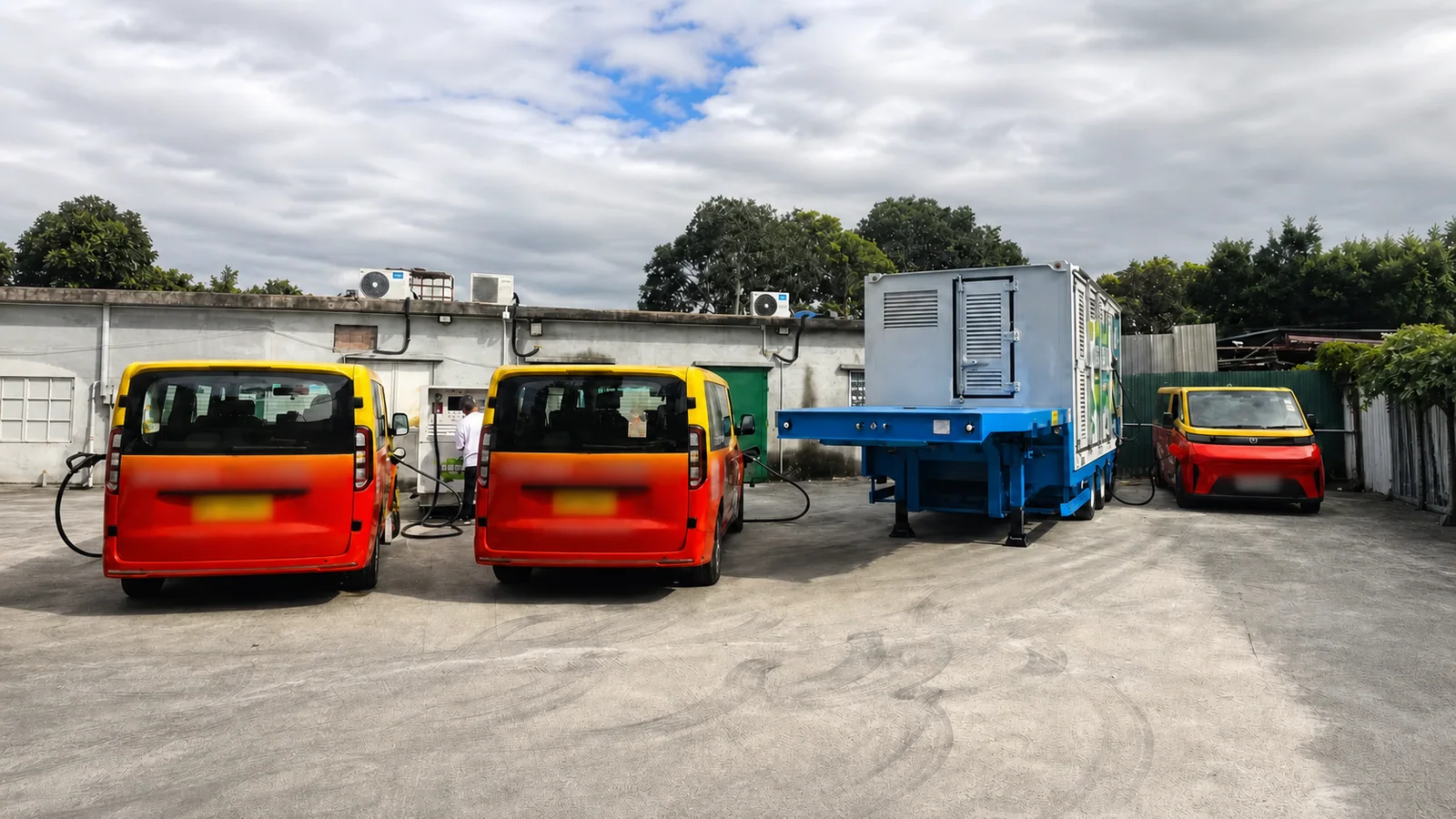
Fleet electrification does not always wait for permanent charging infrastructure. Electric vans may arrive before a utility upgrade is complete. A temporary vehicle compound may operate for only a few months. A depot may have enough grid power overnight but not enough capacity to support the required daytime DC charging load.
In situations like these, a battery-integrated mobile EV charging system can provide temporary or relocatable DC charging capacity. It stores energy first, then delivers that energy to vehicles at a higher DC output when charging is required. The right system, however, cannot be selected from charger power alone. Fleet managers must match stored energy, output power, connector configuration, recharge time and deployment method to the real operating schedule.
This guide explains the questions to answer before requesting a mobile charging proposal.
What Is Battery-Integrated Mobile EV Charging?
A battery-integrated mobile charger combines an energy storage battery with DC charging equipment in a movable, vehicle-mounted or trailer-mounted format. Instead of relying on full charger output from the site connection at the exact moment a vehicle plugs in, the unit can recharge from an approved source over time and later discharge stored energy to an EV.
The U.S. Department of Energy describes the same operating principle for battery-buffered fast charging: a battery energy storage system can draw electricity from the grid at a moderate rate and later discharge stored energy at a higher rate for DC fast charging. DOE guidance notes that this approach may support charging at sites with limited grid capacity, but the additional storage equipment, project economics and operating limits must still be assessed for each deployment.
Mobile equipment adds another benefit: the charging asset can be relocated when fleet routes, parking areas or project sites change. That makes it different from a conventional fixed charger and also means transport, positioning and recharge logistics become part of the design.
When Does a Temporary Fleet Charging System Make Sense?
Mobile charging is not automatically the best answer for every fleet. It is most relevant when the operating problem includes one or more of the following conditions:
- EVs are being delivered before permanent chargepoints or a utility upgrade are ready.
- A fleet needs a temporary charging bridge during construction or depot expansion.
- Vehicles operate from seasonal, leased or temporary compounds.
- Several sites need charging, but demand moves between locations.
- A depot has limited available input power during operating hours.
- Vehicle commissioning, delivery or maintenance creates short-term charging demand.
- A resilience plan requires a movable source of limited emergency charging energy.
Public planning resources in both the United States and United Kingdom emphasise starting with vehicle operations and site capacity. The U.S. Alternative Fuels Data Center recommends considering vehicle duty, charger type, current and future fleet size, electrical capacity and managed charging. UK government guidance similarly notes that fleet depots can have different charging needs and that available site power, load balancing and potential network upgrades should be reviewed early.
The practical question is therefore not “How large is the charger?” It is “What energy must be delivered, to which vehicles, within what time, and how will the mobile unit recover before the next shift?” Review both fleet and logistics mobile EV charging and grid-constrained charging sites when the operating problem overlaps these two scenarios.
1. Calculate the Energy Required Per Operating Cycle
Battery capacity is measured in kilowatt-hours (kWh). It determines how much energy the mobile charger can store, not how quickly that energy reaches a vehicle.
Start with an operating-cycle estimate:
Required vehicle energy = number of charging events × average energy needed per event
For example, if five vans each require approximately 18 kWh before their next route, the planned vehicle-energy requirement is 90 kWh. This does not mean that a nominal 90 kWh mobile system is automatically sufficient. The project team must also account for the mobile unit's operating reserve, conversion losses, environmental conditions, battery state-of-charge limits and any energy required by auxiliary systems.
Use measured fleet data where possible:
- vehicle arrival state of charge;
- energy used on a typical route;
- maximum and minimum daily mileage;
- number of vehicles requiring charging;
- seasonal effects, especially winter operation;
- energy needed to complete the next duty cycle rather than always reaching 100%.
If the vehicles and routes are new, model a normal day and a high-demand day separately. A proposal based only on average demand may leave too little capacity when several vehicles return with a lower-than-expected state of charge. For a broader sizing framework, see how to size a mobile EV charging system.
2. Match DC Output to the Charging Window
Charging power is measured in kilowatts (kW). It describes the rate at which energy can be delivered.
As a simple planning check:
Approximate charging time in hours = energy requested in kWh ÷ effective charging power in kW
If a vehicle needs 30 kWh and can accept the available 60 kW throughout the session, the theoretical calculation is 0.5 hours. Real charging time can be longer because an EV's acceptance power changes with battery temperature, state of charge, charging curve and vehicle limits. Cable, connector and system limits also apply.
Ask these questions before selecting output power:
- How long can each vehicle remain connected?
- What DC power can each vehicle actually accept?
- Must vehicles charge one at a time or simultaneously?
- Is the goal a partial operational charge or a high state of charge?
- What happens when two vehicles return late at the same time?
A higher nameplate output does not solve a shortfall in stored energy, and a large battery does not solve an inadequate charging window. The kWh and kW requirements must be checked together.
3. Decide Whether One or Two Vehicles Must Charge at Once
Connector count affects both workflow and power allocation. A single-output unit can work well when dispatchers can queue vehicles. A dual-output system may suit depots where two vehicles must recover energy during the same dwell period.
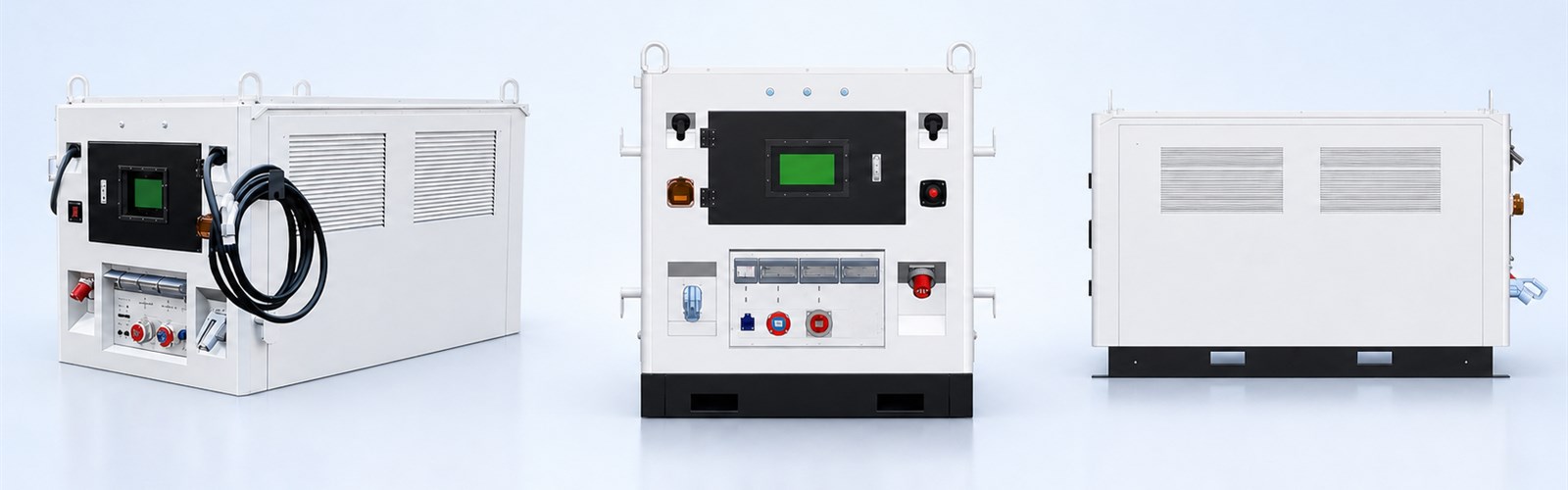
For example, LiCharger's 141 kWh platform can be configured as one 120 kW output or two 60 kW outputs. This is an operational choice, not simply a product upgrade: the fleet must decide whether maximum power to one vehicle or simultaneous service for two vehicles creates the better schedule.
For mixed fleets, also confirm:
- vehicle connector standards;
- cable length and parking orientation;
- output-voltage compatibility;
- whether adapters are permitted by the vehicle and project requirements;
- how charging priority will be controlled when two outputs are active.
Final connector and cable configurations should be agreed before production for the destination market. Use the mobile EV charging connector guide to prepare the vehicle list.
4. Plan How the Mobile Charger Will Be Recharged
The mobile unit is an energy asset that must be replenished. Recharge planning is often the deciding factor in whether the operating model works.
Document the following:
- available AC or compatible DC recharge source;
- continuous power available at that connection;
- hours available between service cycles;
- whether other building loads use the same supply;
- site voltage, frequency, earthing and protection requirements;
- tariff periods or demand-charge considerations;
- contingency plan if the unit returns later than expected.
An illustrative 200 kWh battery cannot be assumed to recharge in two hours from a 100 kW source. Nominal battery capacity is not the same as energy to be replenished, and the real recharge time depends on input limits, starting state of charge, charge profile, losses and auxiliary loads. Request a model-specific recharge calculation rather than relying on capacity divided by input power alone.
Where the site connection is limited, the system may recharge over a longer period and deliver higher power during a shorter vehicle-charging window. Where no reliable recharge source exists, the project may require a larger energy reserve, scheduled off-site recharging or a different operating plan.
5. Choose a Deployment Format That Matches the Site
Compact movable systems
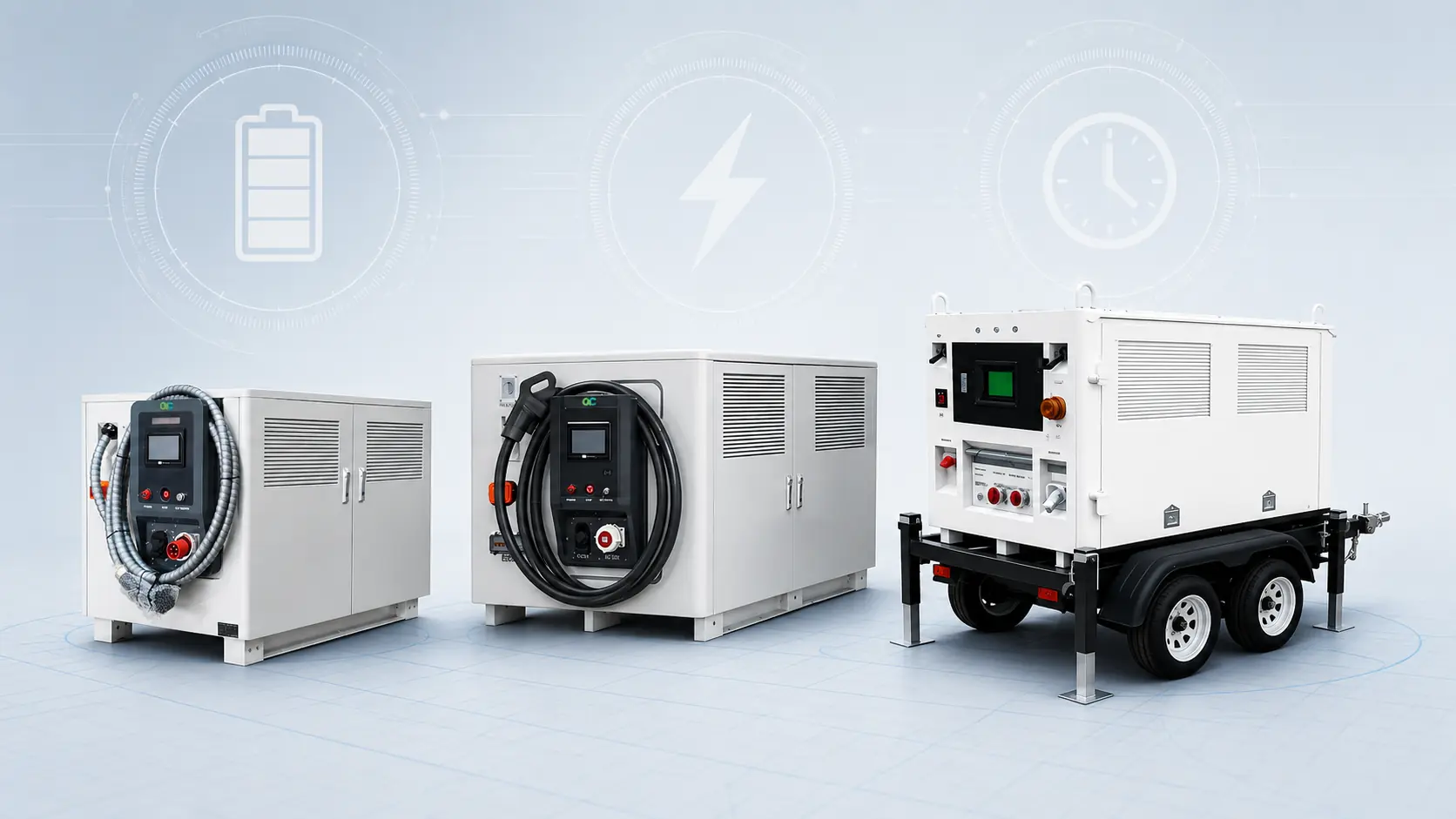
Compact battery-powered DC chargers are suitable for controlled yards, roadside service, vehicle delivery and temporary fleet support where access, footprint and manoeuvrability matter. LiCharger's 75 kWh / 60 kW mobile DC fast charger is the compact starting configuration in the current range.
Higher-output movable systems
Where the project needs more stored energy or shorter charging windows, the 141 kWh / 120 kW mobile DC fast charger adds capacity and offers a single- or dual-output choice. The transport method, loading equipment and safe operating area must be agreed as part of the project.
Trailer-mounted systems
A trailer-mounted mobile EV charger can carry more energy between locations and may suit temporary depots, construction sites, ports, airports and emergency projects. LiCharger's 200 kWh trailer-mounted EV charger is available with project-specific 120 kW or 180 kW output configurations; both versions use dual connectors.
Before selecting a trailer, check towing regulations, gross weight limits, road approval, stabilisation, turning space, weather exposure, parking security and local electrical requirements. A towable format improves relocation options but does not remove the need for a site risk assessment and an agreed operating procedure.
6. Separate OCPP Hardware from the Operator Platform
Fleet buyers often ask whether a mobile charger supports remote monitoring, billing, user management or fault reporting. These functions involve both charging hardware and a compatible charging-station management system.
The Open Charge Alliance defines OCPP as the open communication protocol between charging stations and charging management systems. OCPP 1.6 remains widely implemented, while newer OCPP 2.x versions provide additional capabilities.
LiCharger equipment can be configured with OCPP 1.6J hardware readiness. This does not mean that a local network service, SIM plan, billing system, map, mobile app or remote operations platform is automatically included. The local operator or software provider, network method, required data points, cybersecurity requirements and commissioning responsibilities must be confirmed during the project.
7. Compare the Project Against Three Starting Configurations
The table below is a starting point for discussion, not an automatic selection tool.
| Configuration | Current nominal battery / output | Typical planning use | Important decision |
|---|---|---|---|
| Compact mobile DC charger | 75 kWh / 60 kW | Roadside support, vehicle delivery, small temporary fleet demand | Is one connector and one operating cycle enough? |
| Higher-output movable charger | 141 kWh / 120 kW | Fleet depots, service vehicles and field operations | One 120 kW output or dual 60 kW outputs? |
| Trailer-mounted charger | 200 kWh / 120 kW or 180 kW | Temporary depots, construction, ports, airports and relocatable projects | How will the trailer be transported, positioned and recharged? |
Actual usable energy, vehicle charging speed, simultaneous output, recharge time, connector arrangement, dimensions, weight and compliance documentation must be confirmed for the final configuration.
Information to Include in a Fleet Charging Enquiry
A useful technical enquiry should include more than a requested charger size. Send the supplier:
- destination country and operating location;
- vehicle makes, models and quantities;
- connector type for every vehicle group;
- vehicle battery capacity and accepted DC power;
- arrival and required departure state of charge;
- energy required per vehicle or measured route energy;
- number of charging events per shift;
- available charging window;
- required simultaneous connector count;
- available AC or DC recharge source;
- site voltage, frequency and power limit;
- indoor, outdoor, roadside or trailer deployment;
- transport, lifting and dimensional constraints;
- required delivery date;
- required communication, OCPP and operator-platform functions.
This information allows the project team to test the operating cycle instead of recommending an oversized or undersized system from a single headline specification.
Frequently Asked Questions
Can a mobile EV charger replace permanent depot infrastructure?
It can provide a temporary, relocatable or supplementary charging option, but it is not automatically a permanent-infrastructure replacement. Compare lifecycle cost, operating labour, recharge logistics, site capacity and long-term fleet growth before deciding.
Can battery-integrated charging avoid a grid upgrade?
It may reduce the immediate peak-power requirement or bridge the period before an upgrade, depending on available input power and daily energy demand. It does not create unlimited energy. A site energy study and utility review may still be required.
How many fleet vehicles can one mobile charger support?
There is no reliable answer from battery capacity alone. The number depends on energy delivered per vehicle, vehicle acceptance power, charging windows, simultaneous outputs, reserve policy and how quickly the mobile unit can recharge.
Which connector should a UK or U.S. fleet select?
Choose from the actual vehicles, not the country name alone. UK and European projects commonly use CCS2, while North American fleets may include CCS1 or NACS-equipped vehicles. Mixed fleets must be checked vehicle by vehicle, and the final configuration must meet destination-market requirements.
Does OCPP 1.6J hardware readiness include billing and a mobile app?
No. It provides a communication basis for integration. Billing, user accounts, location services, remote monitoring and mobile or desktop interfaces depend on the compatible operator platform and the agreed integration scope.
Plan the Operating Cycle Before Selecting the Product
A mobile EV charging project succeeds when energy capacity, charging power, connectors, recharge source and fleet schedule work as one system. Start with measured vehicle demand and the worst practical operating day. Then compare compact movable, higher-output and trailer-mounted formats against the site and transport plan.
Review confirmed mobile charging projects, then tell LiCharger the vehicle models, connector types, quantity, daily energy demand, charging window, available input power and required delivery date. Our project team will prepare a model-specific configuration for review.